

Key Takeaways:
- Standard bifold panels range from 600–1,000mm wide, but commercial systems like the Schuco AS FD 75 support panels up to 1,500mm wide and 3,500mm tall.
- A 2-panel configuration spans roughly 1,800mm while an 8-panel setup can exceed 8,400mm — wide enough for a full restaurant frontage.
- Structural support costs climb steeply with opening width: lintels under 2.4m cost £200–£500, while engineered steel for spans above 6m starts at £5,000–£8,000+.
- Commercial bifold doors must meet DDA requirements including an 800mm minimum clear opening, a 15mm maximum threshold upstand, and operating forces per BS 8300.
- Bifold doors cannot serve as the primary entrance to a commercial building — they must be specified as secondary openings alongside a compliant entrance door.
A cafe owner in Shoreditch rang us last spring wanting to open the entire front wall during summer service. The opening measured just over five metres, the ceiling sat at 2,700mm, and the landlord needed proof the structural alterations would not compromise the building above. Within a fortnight, the project had grown to include a structural engineer’s report, a steel beam calculation, DDA-compliant threshold detailing, and a weather performance specification.
Getting bifold door sizes right commercially is nothing like ordering a residential set off a price list. Panel widths, spans, heights, structural requirements, and regulatory compliance all interact — and mistakes are expensive. This guide covers every dimension and specification you need, from a team fitting bi-folding doors and commercial glazing across the UK for over 20 years.
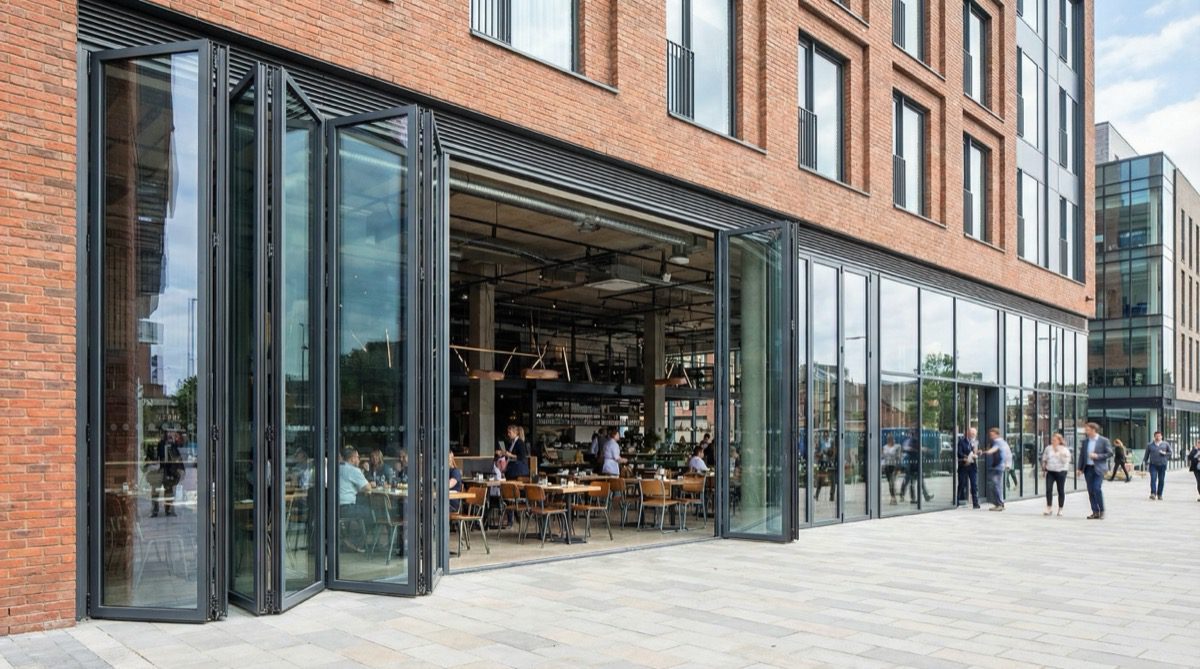
Standard Bifold Door Panel Dimensions
Every bifold configuration is built from individual leaves, and the size limits of those leaves determine what is possible for the opening as a whole.
Standard residential panels run 600–1,000mm wide and 2,078–2,100mm tall. Commercial projects routinely push beyond both of those limits. Wider panels mean fewer joints, cleaner sightlines, and less hardware to service in a high-traffic environment. The Schuco AS FD 75 supports panels up to 1,500mm wide, while Reynaers and Origin handle up to 1,200mm.
Heights follow the same pattern. Many commercial premises have floor-to-ceiling heights of 2,700mm or more, and restaurants and retail showrooms want tall glazing to flood the interior with light.
| Height | Classification | Typical Application |
|---|---|---|
| 2,100mm | Standard | Standard retail units, light commercial |
| 2,400mm | Tall | Most commercial properties, restaurants and cafes |
| 2,700mm | Extra tall | High-ceiling commercial, bespoke systems required |
| 3,000mm | Maximum standard | Premium retail and hospitality (Schuco, Reynaers) |
| 3,000–3,500mm | Bespoke | Showcase commercial, specialist installation |
Commercial panels are also thicker (65–90mm versus 35mm residential) and heavier. Residential hardware handles 50–75kg per leaf; commercial hardware copes with 100–150kg. Specifying hardware rated below the actual leaf weight always leads to premature track and roller failure.
Bifold Door Size Chart by Panel Count
The table below maps panel count to overall width, individual panel width, and the commercial scenarios where each configuration works best.
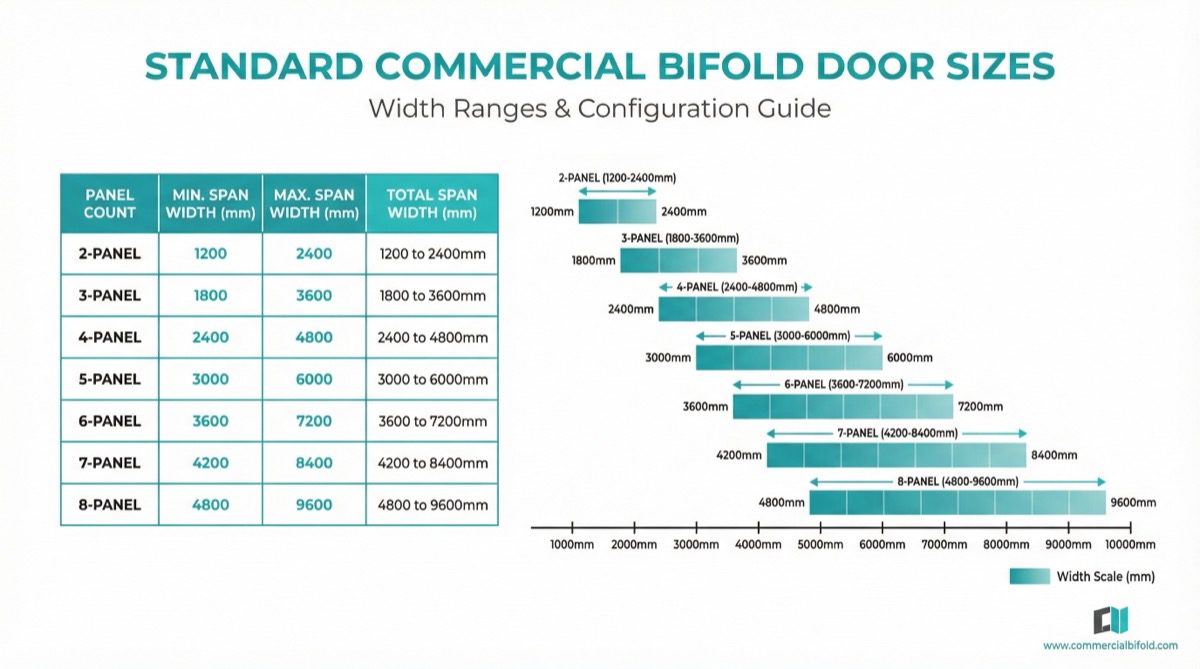
| Panels | Total Width | Panel Width | Commercial Use Case |
|---|---|---|---|
| 2 | 1,800mm (1.8m) | 900mm | Small access opening, secondary back-of-house entrance |
| 3 | 2,400–3,000mm (2.4–3.0m) | 800–1,000mm | Small cafe frontage, narrow retail unit, office meeting rooms |
| 4 | 3,000–4,000mm (3.0–4.0m) | 750–1,000mm | Standard shop front, medium cafe, deli counter opening |
| 5 | 4,000–5,000mm (4.0–5.0m) | 800–1,000mm | Restaurant frontage, large retail showroom, pub garden opening |
| 6 | 5,000–6,000mm (5.0–6.0m) | 833–1,000mm | Large restaurant or bar frontage, gym entrance wall |
| 7 | 6,000–7,200mm (6.0–7.2m) | 857–1,028mm | Full-width restaurant opening, car showroom, gallery |
| 8+ | 7,200–8,400mm+ (7.2–8.4m+) | 900–1,050mm | Maximum commercial span, event venue, flagship retail |
For openings wider than 6 metres, many specifiers split the run into two separate bifold sets that stack to opposite ends. This keeps the leaf count per track manageable, reduces operating effort, and provides more flexibility for partial opening in mixed weather.
Commercial Bifold Door System Specifications
The system you choose dictates maximum panel size, maximum leaf weight, and what configurations are possible. Here is how the main commercial systems compare.
| System | Max Panel Width | Max Panel Height | Max Leaf Weight | Best For |
|---|---|---|---|---|
| Schuco AS FD 75 | 1,500mm | 3,500mm | 150kg | Premium commercial, tall openings |
| Schuco ASS 80FD | 1,200mm | 3,000mm | 120kg | Mid-to-premium commercial |
| Reynaers CS 77 | 1,200mm | 3,000mm | 130kg | Architect-specified projects |
| Smart Visofold 1000 | 1,000mm | 2,500mm | 100kg | Standard commercial, good value |
| Origin OB-72 | 1,200mm | 2,800mm | 100kg | Mid-range commercial |
| AluK BSF70 | 1,000mm | 2,500mm | 100kg | Budget commercial |
Schuco and Reynaers deliver the largest panels and highest weight ratings, giving architects freedom to design with fewer, wider leaves and slimmer sightlines. For a cost comparison between these systems, see our commercial bifold door pricing guide.
Smart Systems is worth noting where lead time matters — as a UK manufacturer, delivery is faster than German or Belgian imports, and the Visofold 1000 handles most openings up to 5 metres. If your project involves aluminium shop fronts, Schuco and Reynaers both offer framing designed to integrate with their bifold ranges.
Structural Requirements by Opening Width
This is where commercial bifold projects differ most sharply from residential. Widening an opening in a commercial building almost always involves structural work, and the cost scales steeply with span.
| Opening Width | Typical Support Required | Estimated Cost |
|---|---|---|
| Up to 2.4m | Standard lintel | £200–£500 |
| 2.4m–3.6m | Upgraded lintel or small steel beam | £800–£2,000 |
| 3.6m–5.0m | Steel RSJ or concrete lintel | £2,000–£4,000 |
| 5.0m–6.0m | Engineered steel beam (structural calc required) | £3,000–£6,000 |
| 6.0m+ | Major structural steelwork | £5,000–£8,000+ |
On top of the beam itself, you will need a structural engineer’s calculations (£600–£1,500) and building control approval (£400–£900). These are legal requirements for any new or widened structural opening in a commercial building.
Get the structural survey done before you commit to a system, not after. A restaurant owner who budgets £10,000 for the bifold but has not accounted for £5,000 in steelwork will face a difficult conversation mid-project. Our shop front cost guide breaks down full project costs including structural work.
DDA Compliance and Accessible Sizing
Any bifold door on a public-facing commercial premises must comply with Part M of the Building Regulations and the Equality Act 2010, meeting the accessibility standards in BS 8300.
| Requirement | Standard | Details |
|---|---|---|
| Minimum clear opening width | 800mm (new builds) | Part M Building Regulations |
| Maximum threshold upstand | 15mm | For wheelchair accessibility |
| Door leaf operating force | Max 30N (opening), 22.5N (closing) | BS 8300 recommendation |
| Colour contrast | Required | Visual contrast strip on glass, contrasting frame |
| Vision panels | Required at 2 heights | 500–800mm and 1,200–1,600mm zones |
The 800mm clear opening is measured with the door leaf fully open. For a bifold, the traffic leaf — the first panel that opens as a conventional door — must provide at least 800mm of unobstructed passage.
Thresholds need particular attention. Standard bifold thresholds sit 20–25mm above floor level, which fails DDA inspection. You need a flush threshold sunk into the slab with drainage beneath, or a low-profile threshold with a maximum 15mm upstand and ramped approaches. Specify this at the design stage — retrofitting flush thresholds is far more expensive.
For toughened glass shop fronts, the vision panel requirement is normally met by full-height glazing, but manifestation markings are still required at both height zones.
Weather Performance Ratings (BS 6375-1)
Commercial bifold doors must meet BS 6375-1 classifications for air permeability, water tightness, and wind resistance. These ratings matter particularly for restaurants and cafes where the opening faces prevailing weather, or for exposed and coastal locations.
| Test | Classification Range | Commercial Minimum | Notes |
|---|---|---|---|
| Air permeability | Class 0–4 | Class 3 | Class 4 for exposed locations |
| Water tightness | Class 0–9A | Class 5A | Higher for restaurants (condensation risk) |
| Wind resistance | Class 1A–5C | Class 3A | Higher for tall or exposed installations |
Schuco and Reynaers typically achieve the highest ratings. Budget systems can struggle to hit the thresholds needed for exposed locations, so check test certificates before ordering.
For hospitality venues, condensation is a particular concern — a packed restaurant with kitchen steam and cold glass will have water streaming down the panels by mid-service. Thermally broken frames and heated thresholds (£800–£1,200) help. Our double glazing versus single glazing guide covers thermal performance in more detail.
Why Bifold Doors Cannot Serve as a Primary Commercial Entrance
This catches out a surprising number of clients. Bifold doors should not be used as the primary entrance to a commercial building.
The hardware — hinges, rollers, tracks, locking mechanisms — is not designed for the repeated daily cycle of a primary entrance. In commercial settings, bifolds are specified as secondary openings. The primary entrance should be a dedicated commercial door — often an automatic door or a purpose-built aluminium shop front entrance — with the bifold providing the option to open the frontage during trading hours or good weather.
Configuration Options and Folding Directions
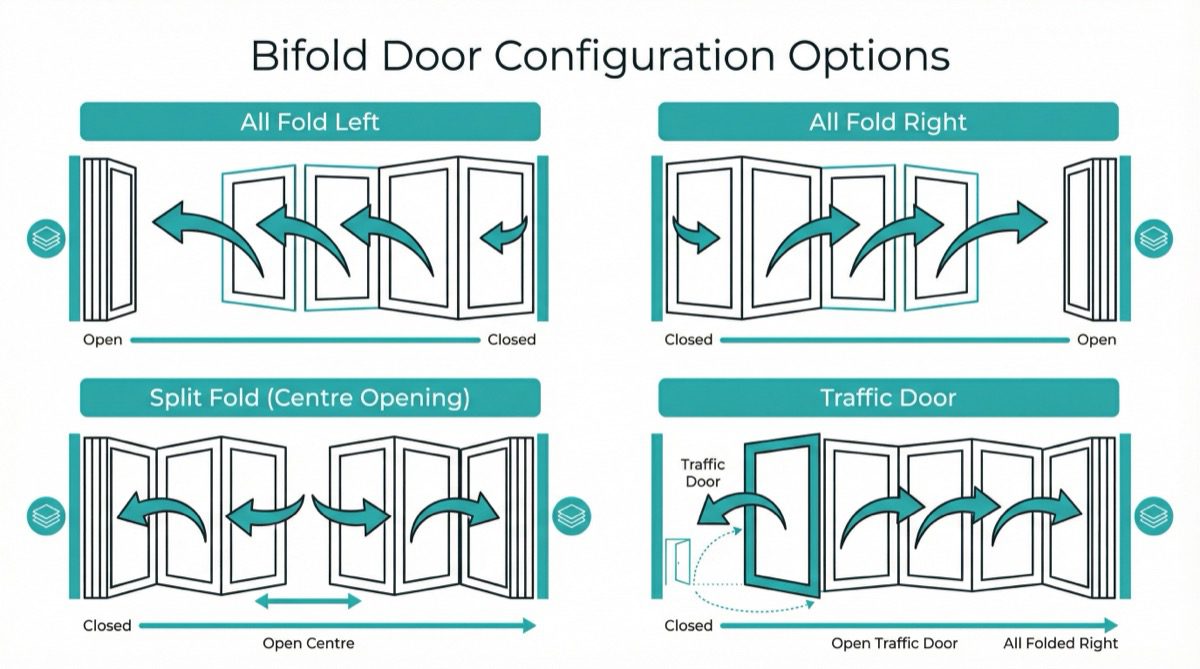
Beyond panel count and size, you need to decide how the panels fold and stack. The main options:
- All panels fold to one side — simplest arrangement, best when one end sits against a wall or corner.
- Split fold (panels fold to both sides) — ideal for wider openings. A 6-panel split might run 3+3, with three panels folding each way.
- Traffic door — one panel operates as a conventional hinged door for everyday access while the rest fold open for full-width opening. This is standard for commercial use.
The traffic door should be positioned closest to the main access point and must provide the 800mm minimum clear opening for DDA compliance. For frontage inspiration, our shop front design ideas show a range of configurations across retail and hospitality.
Choosing the Right Size for Your Project
Small cafe or deli (2.4–3.6m opening): A 3 or 4-panel configuration at 2,100–2,400mm height. Systems like the AluK BSF70 or Smart Visofold 1000 handle these openings without needing premium hardware.
Restaurant or bar (4–6m opening): Typically 5 or 6 panels with a split-fold at 2,400–2,700mm height. You will almost certainly need a steel RSJ, and the system should be mid-to-premium (Schuco ASS 80FD, Reynaers CS 77, or Origin OB-72).
Flagship retail or showroom (6m+ opening): A 7–8 panel single run or two separate bifold sets on independent tracks. Heights of 2,700–3,000mm+ demand the Schuco AS FD 75. Major steelwork is a given. For full project costs, see our bifold doors cost guide.
Frequently Asked Questions
What is the standard size of a bifold door in the UK?
The most common standard is 2,100mm high with panel widths of 600–1,000mm. Overall widths for residential sets range from 1,800mm (2-panel) to 4,800mm (6-panel). Commercial systems extend to 3,500mm tall and over 8,400mm wide.
What is the maximum width for commercial bifold doors?
The widest single-track runs reach 7,200–8,400mm using 7 or 8 panels. For wider openings, two separate bifold sets on independent tracks can cover virtually any span. The practical limit is structural support and budget, not the door system.
How wide can a single bifold panel be?
The Schuco AS FD 75 allows panels up to 1,500mm — the widest available. Most commercial systems cap at 1,000–1,200mm. Wider panels mean heavier leaves, so hardware ratings and DDA operating force limits need checking.
Do wide bifold openings need a steel beam?
Almost always. Openings under 2.4m can usually use a standard lintel (£200–£500). Beyond that, steel beams are needed, with costs rising from £800 at 3m to £5,000–£8,000+ above 6m. A structural engineer’s report is required for any new or widened opening.
What are the DDA requirements for commercial bifold doors?
The traffic leaf must provide 800mm minimum clear opening. Threshold upstand cannot exceed 15mm. Operating force: maximum 30N to open, 22.5N to close (BS 8300). Glass needs manifestation markings at two height zones, and frames must provide visual contrast.
What size bifold doors do I need for a shop front?
Most standard shop fronts use 3–5 panels covering 2.4–5.0m, with a separate external bifold entrance alongside. Measure the structural opening, not the existing frame, and get a professional survey — commercial openings are rarely perfectly square.
What is the difference between residential and commercial bifold door sizes?
Commercial systems are larger and heavier in every dimension. Panel thickness goes from 35mm to 65–90mm. Maximum heights jump from 2,100mm to 3,500mm. Leaf weights double from 50–75kg to 100–150kg. Commercial frames also use deeper thermal breaks and heavy-duty hardware for daily high-traffic use.
Can bifold doors be used as a main entrance to a commercial building?
No. Bifold hardware is not designed to meet Building Regulations for primary entrance doors to non-dwellings. They should be specified as secondary openings alongside a dedicated commercial entrance or automatic door system.
Get the Right Specification for Your Commercial Bifold Project
Getting bifold door sizes right on a commercial project means balancing panel dimensions, system capabilities, structural requirements, DDA compliance, and weather performance — all before committing to a purchase.
At Huxley & Co, we carry out a full on-site survey covering structural assessment, system recommendation, threshold detailing, and regulatory compliance. We work with Schuco, Reynaers, Smart Systems, Origin, and AluK, and we recommend the system that fits your opening, budget, and building.
Call us on 020 7112 4849 or get in touch online to book a free commercial survey. We are FENSA registered, CHAS accredited, and Constructionline certified, with over 20 years of experience fitting bi-folding doors, aluminium shop fronts, and commercial glazing across the UK.